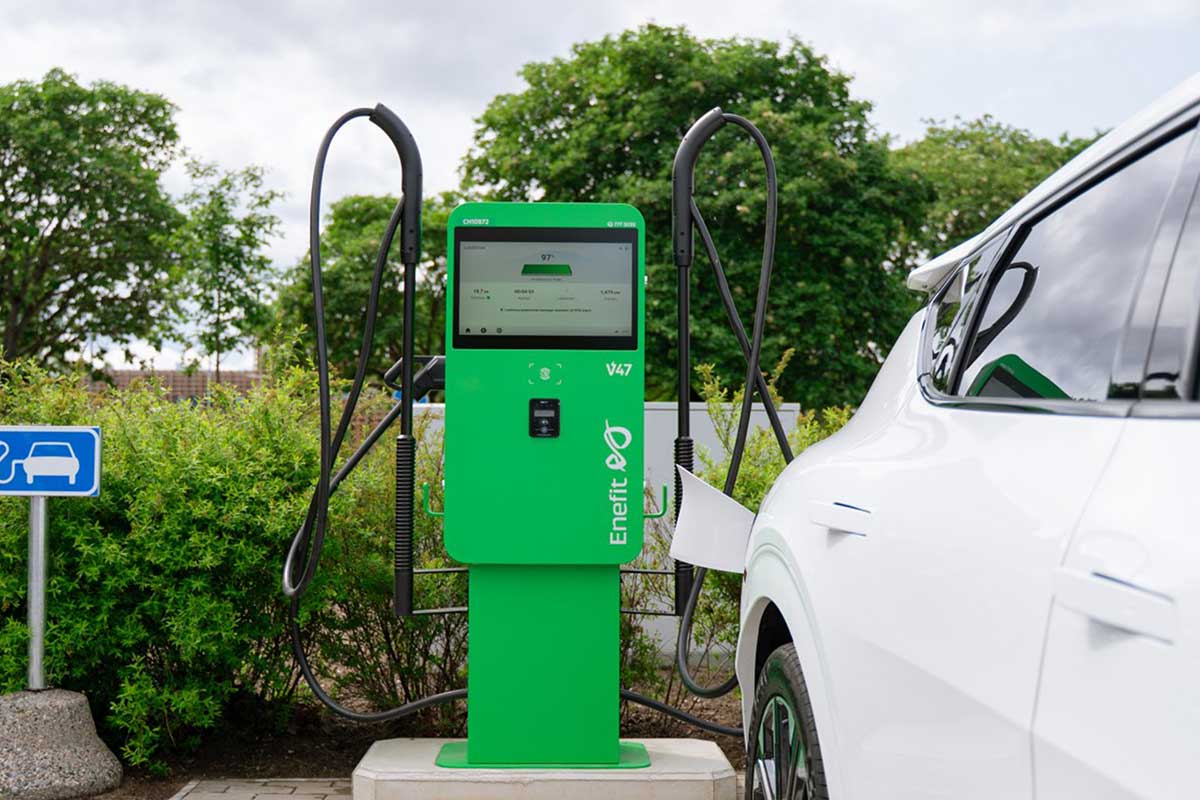
Electric cars are no longer a niche product – they are becoming a mainstream choice for both individuals and businesses. Statistics from early 2026 in Europe show that one in five new cars is already fully electric, while the share of plug-in hybrids is rising rapidly. At the same time, although the overall car market has slightly declined, sales of electric vehicles have grown by more than a fifth. This confirms that the trend is strong and irreversible. For businesses, however, following the trend alone is not enough – what really matters is whether electrification is sensible, cost-effective and reliable.
Elektriautodelt säästate raha – elutsükli kogukulu ütleb kõik
Although the purchase price of electric vehicles may appear higher at the showroom, their total cost of ownership (TCO) is often already lower than that of internal combustion engine cars.
There are several reasons for this. First, ‘fuel’ is cheaper: the cost per kilometre of electricity is lower and the price of electricity is generally more predictable over the long term than that of liquid fuels. Second, electric cars require less maintenance: there is no need for regular oil changes and there are fewer mechanical wear points in the vehicle. Finally, potential tax incentives also influence the overall cost of ownership.
The cost-saving benefits of using electric vehicles are also illustrated by the experience of Eesti Energia, which operates one of the largest electrified fleets in Estonia. The fleet of the company includes more than 100 electric vehicles, with an average TCO of €0.19 per kilometre, compared with €0.28 per kilometre for the entire fleet. On average, electric vehicles are driven more than 16,000 km per year, meaning the savings are substantial.
Widespread charging availability at home, at work and on the road
Charging electric vehicles is rapidly becoming as natural as plugging in a mobile phone.
Even today, Estonia has nearly 2,000 public charging points and the Baltics have around 9,000.
The development of fast chargers has also gained momentum, as by the end of last year, Estonia’s public charging network included:
- 319 charging points with 50–150 kW capacity,
- 434 charging points with 150–350 kW capacity and
- 38 charging points with over 350 kW capacity.
The public charging network is also continuously expanding. This is being accelerated by a European regulation that requires a fast charger at least every 60 km along major roads.
Charging readiness is becoming a requirement for all new buildings as well. In Estonia, it is expected that by 2035 the majority of new cars will be electric – this means that commercial real estate owners should already be considering whether charging facilities are available on their property. From the summer of 2026, all new non-residential buildings, as well as those undergoing major renovations, must have one charger for every five parking spaces. Additionally, provisions must be made to allow the installation of chargers at the remaining parking spaces in the future. This means that when renovating a building or designing a new one, charging readiness should be incorporated from the outset, as subsequent reconstruction is significantly more expensive.
In addition, the charging experience itself is becoming simpler, faster and more intuitive. Charging an electric car no longer requires special knowledge, it is becoming as intuitive as filling up with liquid fuels. For example, Enefit’s network already uses a Plug & Charge solution where the charger automatically recognises both the vehicle and its owner when the charging cable is connected to the car and charging begins without any further steps. Moreover, fragmentation across the entire charging infrastructure is decreasing – for a better user experience, platforms that connect the systems of different charging operators are being developed, eliminating the need for multiple charging apps.
Common myths and reality
- ‘Electric cars are expensive.’ If we focus on the total cost of ownership (TCO) rather than the purchase price, electric cars are more affordable. In most cases, choosing an electric car pays for itself within a couple of years.
- ‘Will the battery last in winter?’ Yes, if battery pre-heating is used and the car is kept plugged in whenever possible. In such cases, most vehicles retain around 85–90% of their summer driving range.
- ‘Fast charging is expensive.’ At the depot, cars can be charged more slowly and economically overnight using AC chargers. DC chargers are suitable during the working day to quickly add driving range. Public charging covers the remaining needs on the road. With this approach, charging costs remain affordable.
How to get started?
- Map the current situation: assess the average mileage of your fleet, main routes, parking and charging options.
- Develop a charging strategy:
- overnight AC charging at the workplace car park;
- fast DC charging at key locations;
- collaboration with a reliable public charging network provider.
- Prepare your buildings: install cabling for electric vehicle parking spaces.
- Establish principles and guidelines for winter use of electric vehicles: pre-heating, driver training and the use of heat pumps.
Electrifying a vehicle fleet is no longer a risky experiment, but a practical and cost-saving measure. Charging networks across Europe and the Baltics are expanding rapidly, and companies that adopt electric vehicles early gain a clear competitive advantage.
Enefit is the largest and most experienced provider of charging solutions in Estonia. Our aim is to offer a seamless user experience at home, at work and on the road. In addition to selling and renting chargers to private and business customers, we are continuously developing the public charging network of Enefit.