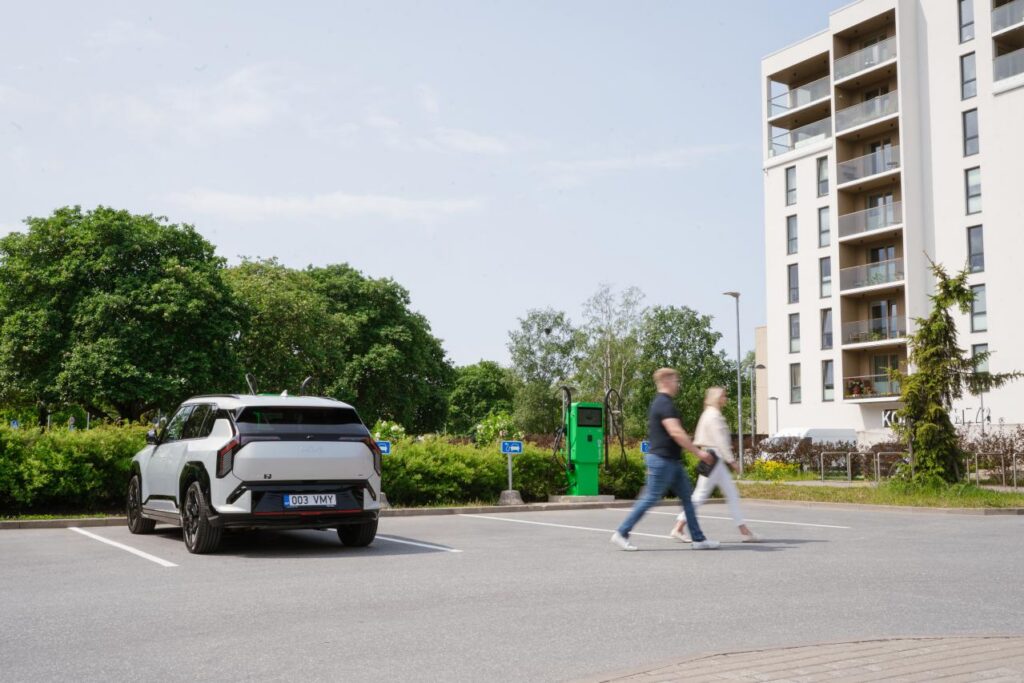
Electric cars are no longer a future concept or something seen only in major cities. In recent years, the number of electric cars in Estonia has grown rapidly and, according to forecasts, this growth is expected to continue. More and more people are turning to electric cars for practical reasons – quiet driving, lower running costs and easier maintenance.
However, owning an electric car raises the obvious question: where and how do you charge it?
How far can modern electric cars travel?
Just a few years ago, many people worried about being left stranded with an electric car, but that concern has largely faded.
- A modern new electric car can travel an average of 400–500 kilometres on a single charge
- Some models can even exceed 550 km, depending on driving style and weather conditions. Here is a comparison of different electric cars: https://auto.geenius.ee/rubriik/pluss-ja-miinus/10-uut-elektriautot-mida-tasuks-oma-ostunimekirja-kindlasti-lisada/
This means that:
- everyday trips (work, shopping, hobbies) can usually be made over several days without charging
- a well-developed public charging network provides support for longer journeys
This is where home charging comes in – the easiest and most convenient way to use an electric car.
Why do most electric car owners charge their vehicle at home?
According to the international IEA Global EV Outlook 2004 report, along with practical experience, 70–90% of everyday charging takes place at home or near home. The reason is simple:
- the car is parked at home overnight anyway
- there is no need to make a special trip to a petrol station / charging point
- electricity is more affordable at home than at a fast-charging station
- Exchange price of charging = battery capacity × electricity price (cents/kWh) / 100 (to convert to euros) / 0.88 (energy loss). Example: an exchange price of 10 cents per kWh and a car with a 60-kWh battery. Other costs, such as the sales margin, are added to the electricity exchange price. We assume an average charging-related energy loss of 12%.
- Exchange price of charging = 60 × 10 / 100 / 0.88 = €6.8
- the car is always fully charged in the morning
With a home charger, an electric car blends seamlessly into everyday life instead of requiring separate planning.
Installing a charger at a private house is usually quick and easy. But why shouldn’t you settle for a basic portable charger?
Installing a charger at a private house is usually quick and easy. But why shouldn’t you settle for a basic portable charger?
Portable charger (without smart charging):
- slow
- does not take electricity prices into account
- does not manage load (may cause power distribution issues)
- inconvenient for daily use and does not guarantee safety
Smart home charger (eg Enefit’s solution):
- charges automatically when electricity is cheapest
- does not overload the home electrical system
- provides insights into energy consumption
- is future-proof (compatible with all electric cars using the standard Type 2 AC connector, ie all electric and plug-in hybrid vehicles sold in Europe)
A smart charger means lower cost per kilometre and greater peace of mind.
Living in an apartment building – is it even possible?
Yes, and it is becoming increasingly common.
Charging in apartment buildings is more complicated due to the following aspects:
- shared electrical capacity and a joint electricity bill
- parking spaces are fixed and often located away from the building etc
- need for joint investment in central equipment
However, the state has created a specific subsidy for apartment buildings. If your family already owns an electric car or is seriously considering purchasing one, it is worth looking into the subsidy offered by the Environmental Investment Centre (EIC), which helps apartment associations set up charging infrastructure at a significantly lower cost.
The subsidy:
- covers a large portion of the cost of chargers and electrical work
- is suitable for apartment buildings and terraced houses
- · applies in specific areas (excluding the surroundings of Tallinn and Tartu). More information: https://kik.ee/et/toetatavad-tegevused/elektriauto-laadimistaristu-toetus
On the road – Enefit’s public charging network keeps you going
Even with the best home charging solution, longer trips are inevitable. The good news is:
- Enefit operates the largest and fastest-growing public charging network in Estonia
- charging stations are located along highways, in cities and at shopping centres
- charging is simple, logical and reliable
This ensures that: you will not be stranded with an electric car, even when home charging is not immediately available.
In summary
Using an electric car is most convenient when:
- charging at home is done intelligently
- there is a reliable public network for longer journeys
- the solution is designed with the future in mind
An electric car does not make life more complicated – a wisely chosen charging solution actually makes it easier.